Blog
Cannabis Seed Auctions: How They Work, How to Bid, and What to Expect
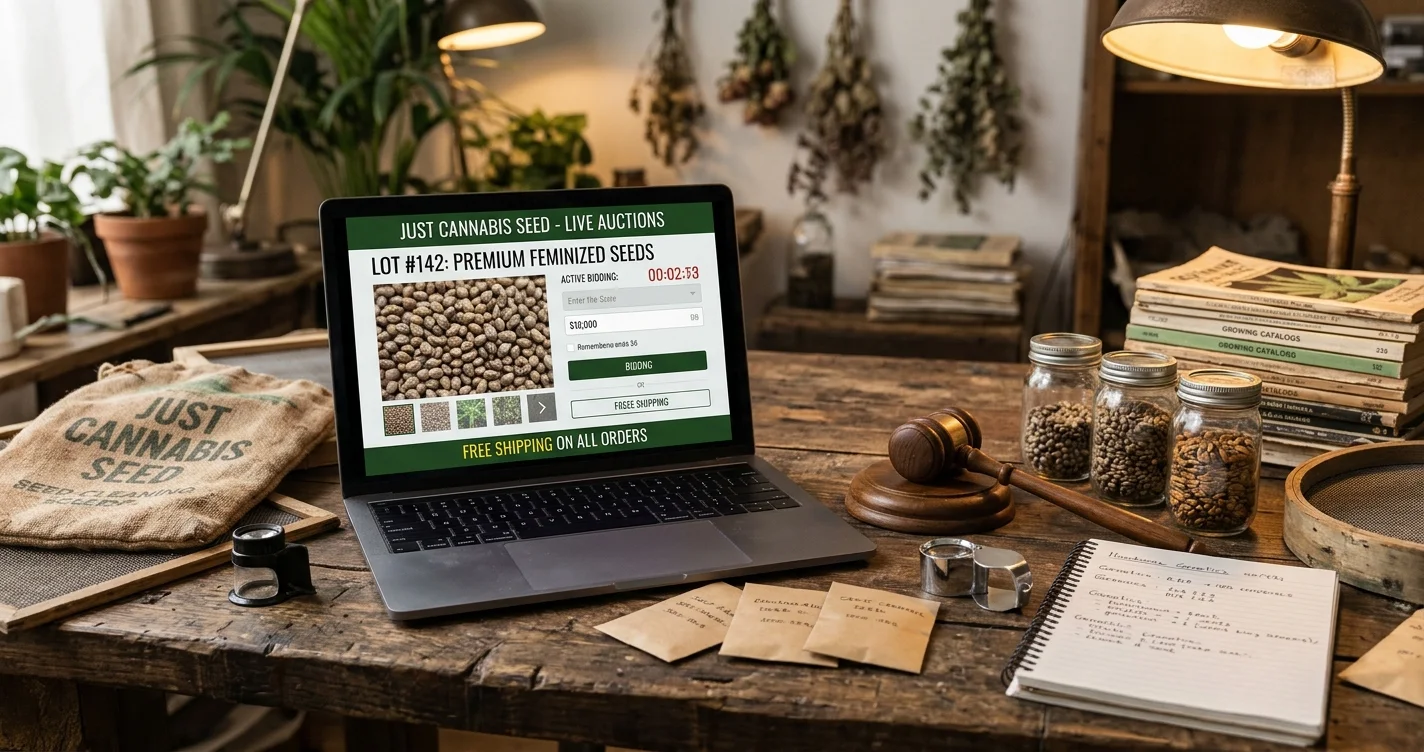
JCS Cannabis Seed Auctions – Safe and Fun, Get Great Deals on Cannabis Seeds
If you have been growing for any length of time, you have probably seen seed auctions pop up online and thought twice before clicking that bid button. I don’t blame you. For a lot of folks—especially old-school growers (like me) who are used to picking a strain out of a catalog, paying a flat price, and waiting for the mailman—online auctions can feel a little intimidating. You start wondering: Am I going to accidentally lock myself into paying way more than I meant to? Are bots going to snipe me in the last two seconds? Is the guy running the auction bidding against me behind the scenes just to drive the price up?
Here is the honest truth: when I first started running these seed auctions myself, I had plenty to learn about how the software actually handles bids, timers, and increments. I have been growing cannabis since 1968, and I know plenty about selecting parents, making crosses, and cleaning seed. Running an online auction house is a whole different animal. You learn fast, you pay attention to where people get tripped up, and if you care about your reputation, you make sure nobody ever gets burned by a confusing button or an honest mistake.
Whether you are thinking about placing your very first bid on a small lot or you just want to understand what happens behind the scenes when the clock ticks down, this guide breaks down how cannabis seed auctions actually work—in plain English, without any fine-print.
The bottom line is I want you to have fun, get some great deals on seeds, and never have to worry about anything bad happening…because it won’t.
Why Do Seed Banks and Breeders Use Auctions Instead of Regular Listings?
The first question most growers ask is simple: If you have seeds to sell, why not just put a price tag on them and list them in the regular store?
There are a few practical reasons why auctions exist in the cannabis seed world, and none of them have to do with making things complicated for the sake of it.
1. Small-Batch Runs and Limited Genetics
When a breeder makes a true small-batch cross—say, an outdoor open-pollination run or a selective F1 pairing from a handful of standout mother plants—there simply aren’t thousands of seed packs sitting around. You might only have a few dozen packs of a specific cross ready to go. If you put a rare, one-off batch into a standard catalog listing at a fixed price, one or two people can buy out the entire stock in five minutes, and nobody else even gets a crack at it. Breaking those limited seed harvests into individual auction lots gives everyday growers a fair shot at putting those genetics in their garden….and pretty much always at a great price.
2. Letting Growers Decide What a Cross Is Worth
Pricing brand-new or experimental genetics is guesswork. Sometimes a breeder spends two seasons working a line and has no idea whether growers will value it at twenty bucks a pack or a hundred. An auction lets the people who actually grow the plants decide what a lot is worth to them. Sometimes a pack goes for way below retail—meaning a grower scores a steal—and other times two people really want that specific cross and bid it up. Either way, nobody is forced to pay a penny more than the number they typed in themselves.
3. Testing New Projects Before Full Production
Breeders constantly run test crosses that may never become permanent catalog staples. Auctions are the natural home for experimental F1s, preservation runs, and guest-breeder collaborations where the goal is getting fresh seeds into the hands of growers who want to grow something unique.
4. Getting My Bulk Genetics In Your Hands For a Great Price
This is the main reason I have decided to have these auctions! I want to get some of my bulk seeds in your coffers before any ban takes place if it ever does. I want you my customer to get some great deals on my cannabis seeds, and have some fun while doing it.
The Basic Mechanics: How Bidding Actually Works
Once you strip away the unfamiliar terms, an online seed auction works a lot like a silent auction at a local fundraiser—except a computer keeps track of the high bid so you don’t have to stand next to a clipboard all day.
Starting Bid (Opening Price)
Every auction lot starts at an opening number set by the seller. That is the lowest amount required to get the ball rolling. If the starting bid is $10 and you are the first person to bid $10, you are officially the high bidder. If nobody else bids before the clock runs out, you win the lot for $10.
Bid Increments (Minimum Raise)
You cannot outbid someone by a single penny. Auction systems use bid increments—set steps that dictate how much higher a new bid has to be over the current high bid. For example, if the current bid is $20 and the bid increment is $2 or $5, the next person has to bid at least $22 or $25. This keeps auctions moving cleanly without people trading ten-cent raises back and forth for three days.
Reserve Price vs. No-Reserve Auctions
You will occasionally hear the term reserve price on auction sites. A reserve is a hidden minimum price the seller has set in the background; if the bidding doesn’t reach that secret number, nobody wins the item even if they are the highest bidder.
Personally, I am not a fan of hidden reserves. When someone takes the time to place a bid and sits at the top of the leaderboard when the timer hits zero, they ought to win the seeds. In a no-reserve auction, the starting bid is the real floor. If you bid the opening amount and nobody outbids you, those seeds are yours—period. I am all about transparency, honesty, and making the time you spend with me at JCS well….fun, and enjoyable.
Proxy Bidding (Max Bidding): The Feature That Confuses Almost Everyone
If there is one feature in online auctions that causes the most confusion—and the most accidental panic—it is proxy bidding, often called auto-bidding or max bidding.
Here is how it works when you type a number into the bid box:
Suppose a seed pack has a current bid of $15, with a $2 bid increment. You decide that the absolute most you are willing to pay for that pack is $40, and you don’t want to sit glued to your phone all evening watching the clock. So you type $40 into the bid box and hit submit.
The auction does NOT immediately jump the price to $40.
Instead, the software puts you in the lead at $17 (just one increment above the previous $15 bidder) and quietly holds your $40 ceiling in reserve.
- If nobody else bids, you win the pack for $17—not $40.
- If someone else comes along an hour later and bids $25, the system automatically bids $27 on your behalf to keep you in first place.
- If another bidder eventually types in $45, your $40 ceiling is beaten, the system notifies you that you have been outbid, and you are completely off the hook unless you choose to jump back in.
Proxy bidding is designed to protect buyers so you only pay just enough to beat the second-highest bidder—never your full ceiling unless someone else pushes you all the way there.
Why Honest Mistakes Happen—And What I will Do About Them
Understanding proxy bidding also explains why a simple typing mistake on a phone keyboard can give someone a heart attack.
Not long ago, I had a fellow bidding on a lot who meant to enter a maximum bid of $200. He was on his phone, hit one extra digit without realizing it, and accidentally submitted $1,200.
Now, on plenty of big corporate auction platforms, if you make a typo like that, tough luck—you are locked into a binding contract, and they will lecture you about reading the terms of service. To me, that is completely backward. Nobody comes to a seed auction hoping to lose a thousand dollars because their thumb slipped on a glass screen.
The moment I saw that $1,200 bid come through, I knew right away what had happened. Nobody was trying to bid twelve hundred bucks on that lot—it was a clear, honest fat-finger mistake. I reached out, cleared the error right away, and put things back where they belonged so he could bid his intended amount without sweating bullets.
I tell that story for one simple reason: if you are bidding with me, I am never going to use a typo, a software quirk, or a misunderstanding to take advantage of you. If you ever hit the wrong key or put in a number you didn’t mean to enter, all you have to do is send a quick message or text, and we will fix it. An auction is supposed to be fun, fair, and exciting—not a trap.
Anti-Sniping Timers: Why the Clock Adds a Few Minutes at the End
If you have ever used eBay in the old days, you probably remember the frustration of losing an auction with 0:01 left on the clock because someone used a computer script—called a sniping bot—to drop a bid in the final half-second before your browser could even refresh.
Modern seed auctions fix that problem with anti-sniping protection (sometimes called soft-close or popcorn bidding).
Here is how it works: if an auction is scheduled to end at 8:00 PM, and someone places a bid with less than two or three minutes remaining, the timer automatically extends by a couple of minutes. Every time a new bid comes in during that final window, the clock resets slightly until a full couple of minutes pass with zero new bids.
That way:
- Bots and fast internet connections don’t give anyone an unfair mechanical edge.
- If someone outbids you at the wire, you actually have time to see the alert, decide if you want to go one step higher, and place a fair counter-bid.
- When the clock finally hits zero, everyone knows the auction ended cleanly.
Shady Auction Tricks to Watch Out For (And How a Fair Auction Differs)
Because online auctions have been around for decades, plenty of buyers have been burned at one time or another—and they bring that healthy skepticism with them when they look at a seed auction. If you know what the dirty tricks look like, it is a lot easier to spot an honest auction from a mile away.
1. Shill Bidding (The House Driving Up the Price)
The oldest trick in the auction book is shill bidding—where the seller, or a buddy working with the seller, places fake bids on their own listing just to push a real buyer’s proxy bid higher. It is dishonest, it ruins trust overnight, and any breeder or seed bank playing that game won’t be around for long.
In a legitimate auction, every single bid comes from a real grower who intends to pay for those seeds if they win. If a lot ends at $12 because only one person wanted it that week, I tip my hat, pack up your seeds, and ship them out with a smile.
Although many auctions can be a couple of folks battling it out to try to win the lot, I guarantee you, I will never shill bid any of my auctions.
2. Fake “Retail Value” Inflation
Some auctions love to slap a big “$250 VALUE!” banner on a basic 10-pack of seeds so that a $60 winning bid looks like the deal of the century. I am not going to do this…thing is I have alot of certain seeds, and I want to get that surplus into your hands, and auctions are a cool way of doing that.
3. Mystery Repackaging and Missing Lineage
If an auction lot won’t tell you whether the seeds are regular (male/female) or feminized, how many seeds are actually in the pack, or what the parent cross is, keep scrolling. You should never have to guess what you are bidding on until the envelope shows up in your mailbox. You will know exactly what you are getting in my auctions here on JCS.
Honoring Runner-Up Bids: How Second-Chance Offers Work
One of the best parts of running small-batch seed auctions directly—without middlemen or giant corporate rules—is having the flexibility to take care of people who came up just short.
Picture this: two growers go back and forth on a limited F1 lot right down to the wire. One person wins it at $45, and the runner-up finishes in second place at $42. Normally, the runner-up goes home empty-handed.
However, when the auction is for a fresh harvest or a small breeder run where there are a few extra packs sitting in the vault, a straight-shooting seller can reach out to that runner-up bidder and offer them an identical pack at their final bid price—or even give them a courtesy bump if the winner fails to pay. You never get forced to buy it, and you never pay a dime more than the exact bid you already placed. It turns a close loss into a win for everybody involved.
And if you are a runner up bidder on any of my auctions simply reach out, and ask if I am able to sell that same lot to you as well….I want all my customers to succeed.
What Happens After You Win? (Checkout, Payment, and Shipping)
For first-time bidders, the biggest unknown is usually what happens the second the clock hits 0:00. Here is the exact step-by-step flow so there are zero surprises:
- You Get an Instant Notification: As soon as the timer runs out, the system sends you an email letting you know you won the lot and showing your exact winning total.
- Checkout Window: You don’t have to be sitting at your computer the exact second the auction closes. Legitimate seed auctions give winners a reasonable window—usually 24 to 72 hours—to log in, review their cart, and complete payment.
- Straightforward Payment Options: On JCS auctions you can pay using the standard checkout method (card, bank/app transfer, or mail-in options) with the exact same privacy and discretion as a regular catalog order.
- Fast Dispatch of Your Winning Seeds: Once payment clears, your winning lot gets packed up and shipped out—usually within one business day—along with tracking info so you can watch it make its way to your mailbox. The only difference between auction seeds, and a regular order on JCS is you will not get all the freebies with the auction seeds…you already likley got a rockin deal!
What Happens If a Winning Bidder Ghosts?
Every now and then, someone wins an auction and disappears without paying. When that happens after the checkout window expires, the unpaid order is simply canceled, the lot either gets offered to the second-highest bidder or relisted in a future cycle, and serial non-payers get blocked from bidding so they don’t ruin the fun for real growers.
6 Beginner Mistakes to Avoid at Your First Seed Auction
If you want to get the best genetics for your money without paying “newbie tax,” keep these six rules in mind before placing your first bid:
- Don’t Bid Emotionally in the First Ten Minutes: When a new auction goes live for a 3- or 5-day run, jumping in and bidding $60 on day one just wakes up the crowd and drives the price up early. Watch the lot, decide your ceiling, and either drop a sensible proxy bid or wait until the final evening.
- Always Check Regular vs. Feminized: Make sure you know whether you are bidding on regular seeds (roughly 50/50 males and females—ideal for breeding and pheno hunting) or feminized seeds before you enter your max number.
- Check the Seed Count: Some auction lots are standard 10-packs, while others are breeder packs of 20, 50, or even mixed multi-strain bundles. Do the quick math per seed so you know what kind of deal you are actually looking at.
- No Need To Factor in Shipping Before Setting Your Max Bid: Shipping is always free at JCS.
- Double-Check Your Digits Before Hitting Submit: Typing $120 instead of $12—or $1,200 instead of $200—happens to the best of us on a phone screen. Take half a second to glance at the number in the box before you click confirm. And if you ever do make an honest typo, reach out immediately instead of panicking I can help.
- Don’t Be Afraid to Ask Questions: If you are ever unsure about how a lot works, how long a strain takes to finish outdoors, or whether a cross leans indica or sativa, text or email me before the clock runs out.
Frequently Asked Questions About Cannabis Seed Auctions
Are cannabis seed auctions legal? In the United States, ungerminated cannabis seeds are sold as novelty souvenirs and genetic preservation items containing less than 0.3% Delta-9 THC under federal hemp guidelines. Always check your local and state laws regarding germination and cultivation in your area.
Can I cancel a bid if I make a typing mistake? On automated corporate auction sites, canceling a bid is often difficult. On direct breeder and seed bank auctions run by real people, if you make an honest fat-finger typo, reach out right away by text or email and I will fix it for you immediately. You are always safe here on JCS.
Do I have to sit at my computer when the auction ends? No. If you enter your maximum bid using proxy bidding, the software will automatically bid on your behalf in small increments up to your limit—and only as high as needed to beat the next bidder.
Why did the auction clock add two minutes right before ending? That is anti-sniping protection. Whenever a bid comes in during the final two or three minutes, the timer extends slightly so everyone has a fair chance to respond without losing to automated last-second scripts.
What if two people bid the exact same maximum amount? In standard auction software, whoever placed that maximum bid first holds the tie-breaker and stays in the lead at that price.
Conclusion
I want everyone’s experience with the Just Cannabis Seed website to be fun, and I want you all to get some great genetics for a great price. So put your fears aside, and go make a bid! Here is that link….Cannabis Seed Auctions – Live Bidding & Free Shipping | Just Cannabis Seed
Never Miss a Field Note or Grow Update
Get direct heads-up emails whenever new grow guides, strain stories, and farm trials are posted.
Join the JCS Email List• ⚡ Live Bidding! Cannabis Seed Auctions
• Who is the Ghost? (My Reveal)
• Cannabis Growing Guide 2025-2026
• Real Customer Testimonials & Reviews
• Real Customer Harvest Photos
This article is provided for educational and informational purposes only. It is not intended as cultivation or grow advice, nor does it encourage any illegal activity. All cannabis seeds sold on JustCannabisSeed.com are novelty items, souvenirs, and collectibles only. Germination and cultivation of cannabis seeds may be illegal in your jurisdiction—you are solely responsible for complying with all local, state, and federal laws. We do not condone breaking any laws. For full details, please read our Disclaimer, Terms & Conditions, and Privacy Policy.